
I. Cooling Surface Test
Many manufacturers dive straight into production without conducting specific, standalone cooling tests. In reality, a simple procedure suffices: fully melt the paraffin wax, pour it into a basic mold or container, allow it to cool naturally, and then observe the surface condition to determine if crystallization is uniform. If the surface remains flat and smooth after cooling, it indicates a stable structure; conversely, if ripples, granular textures, or depressions appear, it likely points to issues with uneven crystallization or fluctuations in oil content. This test costs virtually nothing, yet it allows you to anticipate—and potentially prevent—future problems such as surface rippling or shrinkage cavities. Prior to shipment, Junda Wax conducts internal stability verifications similar to this to ensure that the paraffin wax our customers receive demonstrates highly consistent cooling performance.
II. Thin-Layer Transparency Test
Many people judge Fully Refined Paraffin Wax solely by the color of the solid block—a metric that is actually of limited significance. A far more effective approach is to perform a thin-layer test: pour the molten wax into a thin sheet and observe its light-transmitting properties. If the wax appears clean and possesses a slight translucence, it suggests a thorough refining process; however, if it looks gray, dull, or cloudy, it often indicates the presence of impurities or structural defects. This test is particularly crucial for manufacturers of white candles and scented candles, as end consumers are highly sensitive to visual aesthetics. For its various grades of Fully Refined Paraffin Wax, Junda Wax tailors the refining depth to suit specific application requirements, thereby helping customers achieve superior and consistent visual results in their finished products.
III. Mold Release Test
Mold release performance serves as a remarkably honest indicator of wax quality. Under normal conditions, semi refined paraffin wax should release from a mold cleanly and crisply—neither sticking nor feeling excessively slippery. If the release is overly smooth—to the point of feeling oily—it may suggest an excessively high oil content; conversely, if the wax adheres severely to the mold, it likely points to underlying structural issues or improper cooling conditions. Many manufacturers only discover mold release anomalies during mass production; however, these issues can be entirely avoided through proper testing during the preliminary stages. When classifying its paraffin grades, Junda Wax provides tailored recommendations for different applications—such as pillar candles, tea lights, and container candles—to minimize the need for repetitive trial-and-error during the production process.
IV. Small-Batch Burn Test
Some semi refined paraffin waxes may look impeccable on the surface but exhibit unstable burning characteristics—such as a flickering flame that fluctuates in size, an uneven melt pool, or irregular fragrance release. In such instances, a small-batch burn test becomes absolutely critical. We recommend conducting basic burn tests during the material selection phase to evaluate flame stability, melt pool depth, and fragrance diffusion. This proactive approach allows you to identify and resolve potential issues early on, rather than waiting for customer complaints to prompt necessary adjustments. When providing samples to clients, Junda Wax also recommends conducting burn tests in conjunction with other evaluations to ensure that the final performance meets expectations.
V. Tactile and Fracture Tests
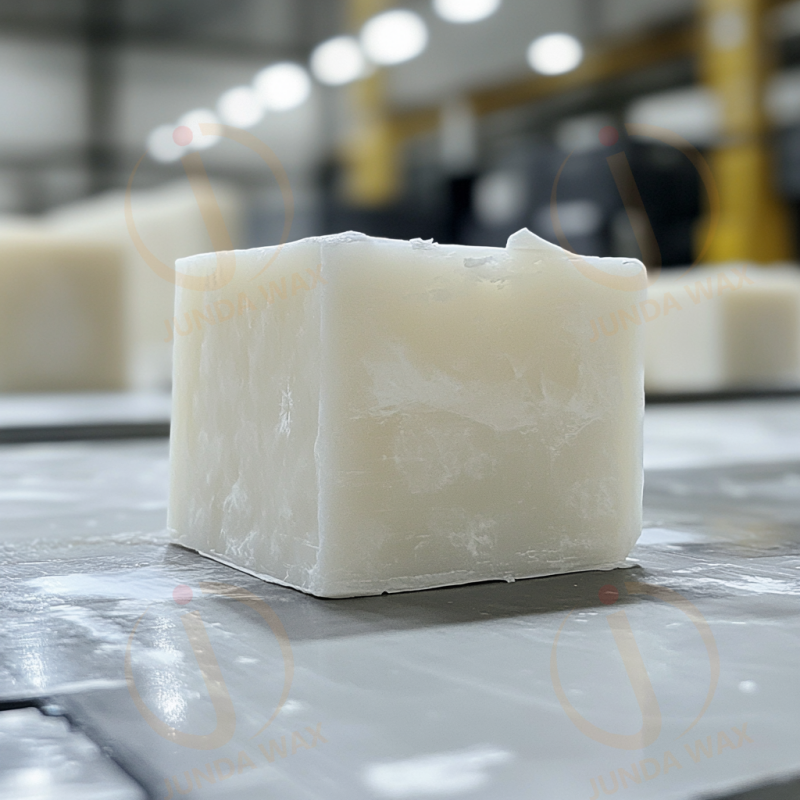
Touching and breaking the wax are highly effective methods for assessment. High-quality paraffin wax should feel dry and non-greasy to the touch, and its fracture surface should appear fine and uniform. If the wax feels slippery or the fracture surface exhibits a distinct oily sensation, it likely indicates an excessively high oil content. While this method may lack the precision of laboratory data, it is highly practical for routine quality inspections. Throughout our long-term supply relationships, Junda Wax places great emphasis on this type of intuitive consistency, ensuring that clients can perceive batch-to-batch stability even without conducting complex laboratory analyses.
VI. Why Are These Tests Often Overlooked?
The reason is actually quite simple: these tests are not standardized—unlike parameters such as melting point and oil content, which yield specific numerical values. However, precisely because they closely mirror real-world application scenarios, they possess even greater practical value. Many manufacturers rely too heavily on data reports while neglecting actual production performance, a oversight that often leads to a concentrated outbreak of issues during later stages. Among the clients we have worked with, those who have established comprehensive sample testing protocols consistently demonstrate significantly higher product pass rates and greater overall stability. In the course of our extensive export operations, Junda Wax goes beyond merely supplying raw materials; we also assist clients in establishing more rational and effective strategies for material selection and testing.
Selecting semi refined paraffin wax involves looking beyond mere technical specifications to focus on actual performance. Seemingly simple tests—such as those for cooling behavior, transparency, mold release properties, and combustion characteristics—can often reveal critical issues early on, thereby helping you mitigate risks further down the production line. If you are currently optimizing your product formulations or vetting a potential new Kunlun paraffin wax company, we encourage you to incorporate these testing methods into your evaluation process. Junda Wax offers not only a comprehensive range of fully refined paraffin waxes in various specifications but also provides a one-stop supply solution encompassing wax wicks, color pigments, and candle-making equipment, complete with expert recommendations tailored to the specific demands of different markets. If you are looking to elevate your standards regarding raw material stability and production efficiency, please do not hesitate to contact us; together, we can ensure that every detail of your production process is executed with uncompromising solidity.
