
For those who have long been involved in candle making, touch is often a quick way to determine whether a batch of paraffin wax is suitable for their product. Of course, touch is not a substitute for testing, but it is a very practical preliminary judgment method. For many years, when receiving customers for inspection at the Junda Wax factory, we have often allowed them to touch samples on-site to compare the hardness differences between different grades of paraffin wax.
Feeling the Paraffin Wax Surface Dry and Smooth?
High-quality fully refined paraffin wax should feel dry at room temperature, not sticky or oily. If you gently run your finger across the surface and it feels smooth and delicate without a noticeable oily film, it indicates that the oil content is reasonably controlled. Conversely, if it feels slightly oily, or even leaves a noticeable mark on your finger, it often means that the oil content is too high. This type of paraffin wax is prone to deformation or oil seepage under columnar wax conditions or high-temperature transportation environments. Junda Wax strictly controls the oil content range before shipment to ensure that the touch and hardness of paraffin wax for different applications are consistent.
Observe the Pressure Resistance by Pressing the Edges and Corners
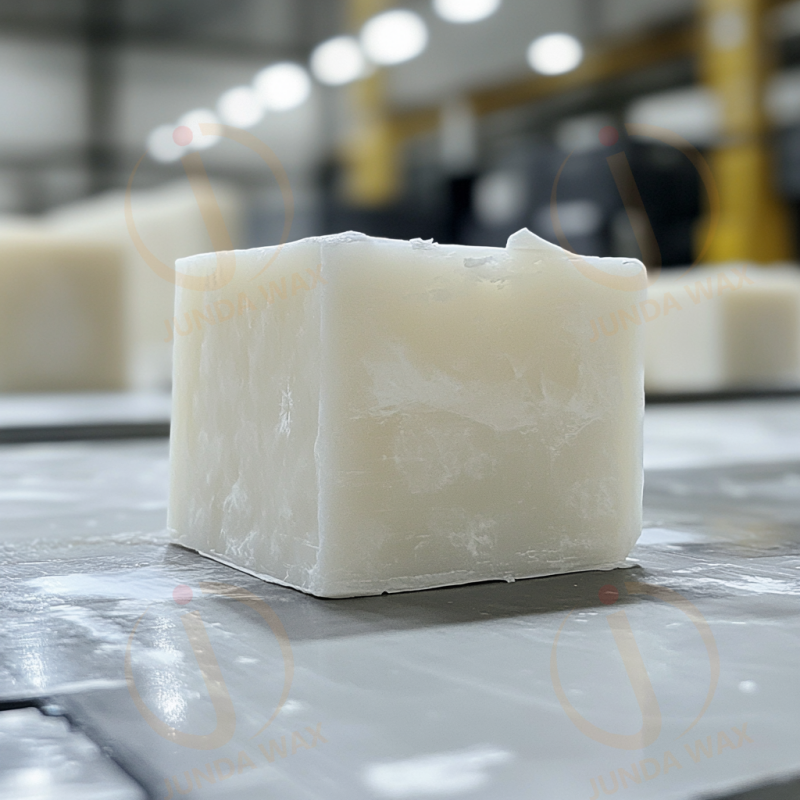
You can use your thumb to lightly press the edges and corners of the paraffin wax block to test its resistance. If a slight pressure causes a noticeable dent, the paraffin wax is too soft and is generally more suitable for products requiring high fluidity, but not for structurally supportive candles. If there is almost no noticeable deformation after pressing, it is harder and more suitable for columnar or sculpted waxes. Of course, the test must be conducted under the same temperature conditions; otherwise, ambient temperature will affect the judgment. In the Junda Wax production process, we adjust the combination of melting point and oil content according to different market demands to match the hardness to specific application scenarios.

Break and observe the cross-section
If possible, break off a small piece and observe the cross-section. A moderately hard, fully refined paraffin wax should have a relatively fine cross-section, showing uniform granules, rather than obvious oil lines or layers. If the cross-section is shiny and has a noticeable oily feel, it usually indicates a high internal oil content. For customers making high-end scented waxes or exporting to the market, the uniformity of the internal structure is crucial, as it directly affects the stability during combustion. Junda Wax has exported to many countries and regions for many years, ensuring the uniformity of the internal structure of the paraffin wax through a stable refining system.
Judging by Intended Use
Many customers mistakenly believe that the harder the paraffin wax, the better, which is not entirely true. Tea wax requires balanced combustion, scented wax requires good fragrance release, and sculpting wax emphasizes structural strength. Hardness is merely one indicator for matching product type, not necessarily the higher the better. We usually recommend fully refined paraffin waxes in different hardness ranges based on whether the customer is making tea wax, pillar wax, or container wax. We also provide wax lines, color powders, and candle production equipment to help with overall matching, rather than adjusting a single material.
Stability is very important
Judging paraffin wax hardness by touch is a quick and practical method, but what's truly important is batch-to-batch stability. Many problems are not due to a particular batch being too soft or too hard, but rather significant differences between batches, requiring repeated adjustments to production parameters. Junda Wax, relying on stable raw material sources and large-scale production capabilities, ensures consistent supply of the same specifications over the long term, which is especially important for customers with export orders.
By touching the surface, pressing the edges, and observing the cross-section, one can initially determine whether the paraffin wax hardness is appropriate. However, the final judgment must still be based on the specific candle type and combustion test results. Choosing the right hardness range for your product is more crucial than simply pursuing a particular parameter. If you're looking for a stable, long-term paraffin wax supplier, Junda Wax not only offers a wide range of fully refined paraffin waxes but also provides a one-stop solution for all the materials and equipment needed for candle production, giving you greater control over your products from raw materials to finished goods. If you require large quantities of paraffin wax for candle production, please feel free to contact us. We will provide you with the highest quality paraffin wax at competitive prices.
