
With the continuous growth of global candle market demand, more and more candle manufacturers are introducing automated production lines to increase capacity, reduce labor costs, and ensure product consistency. However, many factories have found after upgrading their equipment that automated production is not simply a matter of buying a set of machines. If the paraffin wax properties are unstable, even with advanced equipment, problems such as filling errors, poor molding, difficulty in demolding, and even frequent downtime may occur.
In fact, the requirements for paraffin wax in automated candle production lines are often higher than those in traditional manual production. This is because machines can maintain fixed parameters, but once the raw materials fluctuate, the equipment will immediately amplify these differences. Therefore, for automated production plants, choosing stable candle-grade paraffin wax is often more important than simply pursuing the lowest price.
The melting point of the paraffin wax must remain stable.
In the automated production process, the wax melting system is usually set within a fixed temperature range. If the melting point of different batches of paraffin wax fluctuates significantly, it can easily lead to changes in fluidity.
When the melting point is too low, the paraffin wax flows too quickly, which may result in problems such as overfilling and prolonged cooling time; when the melting point is too high, it may lead to insufficient flow, incomplete filling, or increased equipment energy consumption. For high-speed production lines, even a difference of only 1°C to 2°C in melting point can affect the consistency of an entire batch of products. Therefore, automated production plants typically focus more on the stability of the paraffin wax's melting point than just the nominal value.
Junda Wax has long supplied fully refined paraffin wax products to candle manufacturers worldwide, rigorously controlling the melting point stability between different batches to help clients improve the efficiency of automated production.
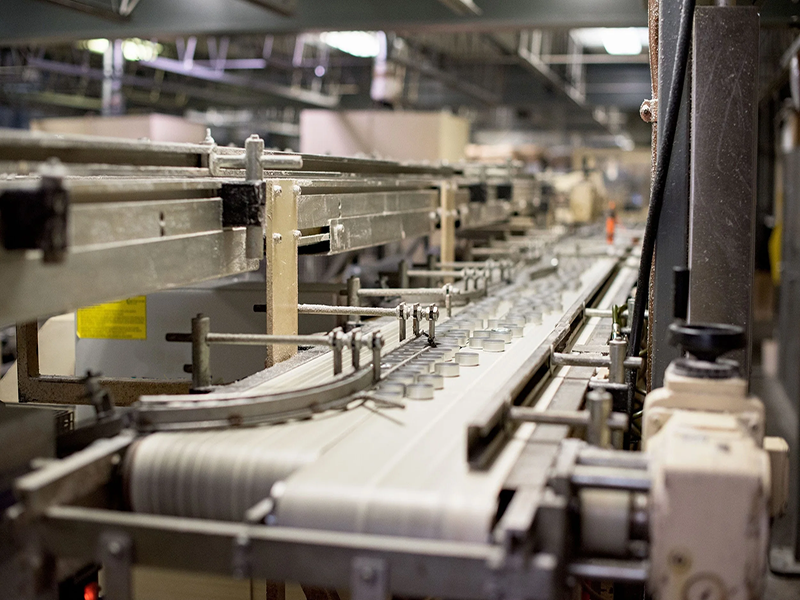
Oil content affects production rhythm.
Many factories tend to overlook the oil content indicator when selecting paraffin wax, but for automated production, oil content directly affects the wax's hardness, cooling rate, and demolding performance.
If the oil content is too high, the wax tends to be softer, increasing cooling time and potentially affecting the production cycle; it can also lead to problems such as surface stickiness and difficulty in demolding.
Conversely, fully refined paraffin wax with low oil content typically forms a more stable crystalline structure, making candles easier to shape and improving the stability of the production line.
Therefore, most automated production lines for columnar candles, tea candles, and religious candles prefer to use high-purity fully refined paraffin wax.
Flowability Determines Filling Accuracy
One of the biggest characteristics of automated production lines is high-speed continuous filling.If the flowability of paraffin wax is unstable, the following problems can easily occur:
Weight deviation of individual candles
Inconsistent liquid level
Product size errors
Reduced filling speed
Especially in high-speed production fields such as tea wax and birthday wax, the requirements for paraffin wax flowability are even higher.
Stable, fully refined paraffin wax can maintain uniform flow at a fixed temperature, thereby helping equipment achieve accurate filling and improving product consistency.
When serving automated production customers, Junda Wax recommends different melting points and hardness specifications based on equipment type and product structure to help customers achieve better production performance.
Cooling Performance Affects Capacity
Many factories believe that the faster the automated equipment, the better. However, in reality, production efficiency is often limited by the cooling rate.
If the paraffin wax cooling time is too long, it will reduce the turnover efficiency of the entire production line; if it cools too quickly, it may lead to uneven shrinkage, surface cracks, or internal voids.
Therefore, automated production usually requires paraffin wax to have uniform and predictable cooling performance.
High-quality, fully refined paraffin wax, with its more stable crystal structure, allows factories to more precisely control production cycles, thereby improving equipment utilization.
Automated production relies heavily on batch consistency.
In manual production, operators can adjust according to actual conditions, but automated equipment typically operates according to preset programs.
This means that the smaller the data fluctuations between different batches of paraffin wax, the more stable the production process.
Many large candle factories now prioritize paraffin wax consistency in their procurement, focusing on:
Melting point stability
Oil content stability
Penetration stability
Color consistency
Burning performance consistency
These seemingly minor indicators directly impact the operating efficiency and yield of automated production lines.
Junda Wax has established a rigorous quality control system during exports, helping customers reduce production problems caused by raw material fluctuations.
In the era of automation, one-stop supply is becoming increasingly important.
With the development of automated production, more and more factories are realizing that simply purchasing paraffin wax is no longer sufficient to meet production needs. Because the final quality of candles depends not only on the paraffin wax but also on the following factors:
Wax thread specifications
Pigment stability
Fragrance compatibility
Mold design
Performance of automated equipment
If these components come from different suppliers, troubleshooting can become extremely complex. Therefore, more and more new candle factories and expansion projects are opting for one-stop suppliers.
Junda Wax not only provides fully refined paraffin wax, semi-refined paraffin wax, and Candle Grade Paraffin Wax with different melting points, but also wax threads, dyes, fragrances, and automated candle production machinery.
Whether it's a tea candle production line, a column candle production line, birthday candle equipment, or automated religious candle production equipment, we can provide comprehensive solutions tailored to customer needs, helping them reduce supply chain management costs and improve project start-up efficiency
